FM Synthesis
FM synthesis, widely recognized as the foundation of the YAMAHA DX7, is a method that generates complex overtones by rapidly modulating the frequency of one sine wave with another. It is regarded as a major technological innovation in the history of electronic music. The birth of this technique is closely tied to the aesthetic vision and intellectual outlook of its inventor and composer, John Chowning.
John Chowning, born in 1934, is an American composer who studied musicology and composition at Stanford University before engaging in research on electronic and computer music. From the late 1960s, he began experimenting with FM sound synthesis, and in 1973, through a licensing agreement with YAMAHA, he laid the foundation for commercial synthesizers. At the same time, Chowning developed a unique methodology that connected technology with compositional theory through his research and compositional practice at IRCAM. Notably, Chowning did not create FM synthesis through mathematics or theory alone; rather, he discovered sounds by ear during experimentation and later substantiated them theoretically.
YAMAHA DX7の基盤として広く知られるFM音響合成はサインウェーブの周波数を別のサインウェーブで高速にモジュレーションさせることで複雑な倍音を発生させる理論で、エレクトロニックミュージック史において極めて重要な技術革新と考えられています。この技術の誕生には、FM音響合成の発明者であり作曲家のJohn Chowningの美学と思想が深く関わっています。
John Chowningは、1934年生まれのアメリカ人作曲家であり、スタンフォード大学で音楽学と作曲を学んだ後、電子音楽やコンピュータ音楽の研究に取り組みました。1960年代後半からFM音響合成の実験を開始し、1973年にはYAMAHAとのライセンス契約を通じて商用シンセサイザーの礎を築きました。同時に、ChowningはIRCAMでの研究や作曲実践を通して、技術と作曲理論を結びつける独自の方法論を確立しました。特筆すべき点はChowningは数学や理論でFM音響合成を生み出したのではなく、実験の中で耳で発見した音を後から理論的に裏付けていった点です。
Stria (1977)
ストゥライア
Music Publisher: B. Schott's Söhne International, Mainz
℗ 1988 Wergo
Stria · John Chowning
Twentieth century Western music often appears to be driven by technology, yet even the most technically oriented works carry the worldview of their composers and the atmosphere of their era. These elements have continually shaped the forms of sound. The FM synthesis invented by John Chowning is no exception. It was not a case in which composers simply supplied effective demonstrations for devices developed by manufacturers. Rather, manufacturers turned the sounds invented by a composer into actual products. This article approaches FM synthesis with that background in mind. Instead of limiting the discussion to equipment or theoretical mechanisms, it uses Stria, a work that embodies a new harmonic outlook of the twentieth century, as an entry point to explore the distinctive resonance and beauty FM can create. The aim is not to turn technical explanation into an end in itself, but to consider how technique becomes integrated into a work, and to look toward the creative processes that lie beneath that transformation.
Stria, created by John Chowning in 1977, is an electronic music work widely regarded as a landmark demonstration of the artistic potential of FM sound synthesis. The piece is neither a mere technical experiment nor a showcase of electronic sounds; by placing frequency ratios and spectral structures at the core of its composition, it produces sonorities that transcend traditional Western harmonic concepts. Its close integration of timbre and structure marks it as a masterpiece of contemporary music and a work that influenced the later spectral music movement.
What is particularly remarkable about this work is that FM sound synthesis functions not merely as a tool for generating new timbres, but as a compositional technique that shapes the very structure of the piece. In Stria, tuning, timbre, and temporal structure are integrated, allowing the sonic world to unfold like a vast wave. While it is possible to understand the technical mechanisms of FM in advance, listening to the work first and attending to how FM’s distinctive harmonic expressions shape our perception can provide an important key to grasping the technology itself.
20世紀の西洋音楽は技術が先行するように見える作品であっても、その背景には作曲家が抱く世界観や時代の空気が含まれており、それらが音響のかたちを左右してきました。Chowningが発明したFM音響合成も例外ではありません。メーカーが開発した機材の有効なデモを作曲家が作っていたのではなく、作曲家が発明した音をメーカーが製品化したのです。 この記事ではそのような背景を踏まえ、機材や理論的な仕組みの紹介だけにとどまらず、二十世紀の新しい和声観を象徴する音楽作品Striaを一つの入口としながら、FMがもたらす固有の響きと美を探ります。技術の説明を目的化するのではなく、技術がどのように作品へと結びつくのか、その深層にある創造のプロセスを眺めていきたいと思います。
Striaは、John Chowningが1977年に制作した電子音響作品であり、FM音響合成が持つ芸術的可能性を示した代表的な成果として位置づけられています。この作品は単なる技術実験でも電子音の見本市でもなく、周波数比やスペクトル構造を作曲の核に据えることで、従来の西洋的和声観を越える響きを描き出し、のちのスペクトル楽派にも影響を与えた音色と構造が深く結びついた現代音楽の傑作です。
この作品で特筆すべきは、FM音響合成が単なる新しい音色生成の道具にとどまらず、作品の骨格そのものを形づくる作曲技法として機能している点です。Striaでは音律、音色、時間構造が一体となり、大きな波のように音の世界が広がります。FMの技術的な仕組みを先に理解することも可能ですが、まず作品を聴くことで、FMならではの倍音表現がどのように聴感覚を形成しているかに耳を澄ませることが、技術理解への重要な手がかりになるのではないでしょうか。
黄金比とStriaスケール
黄金比とStriaスケール
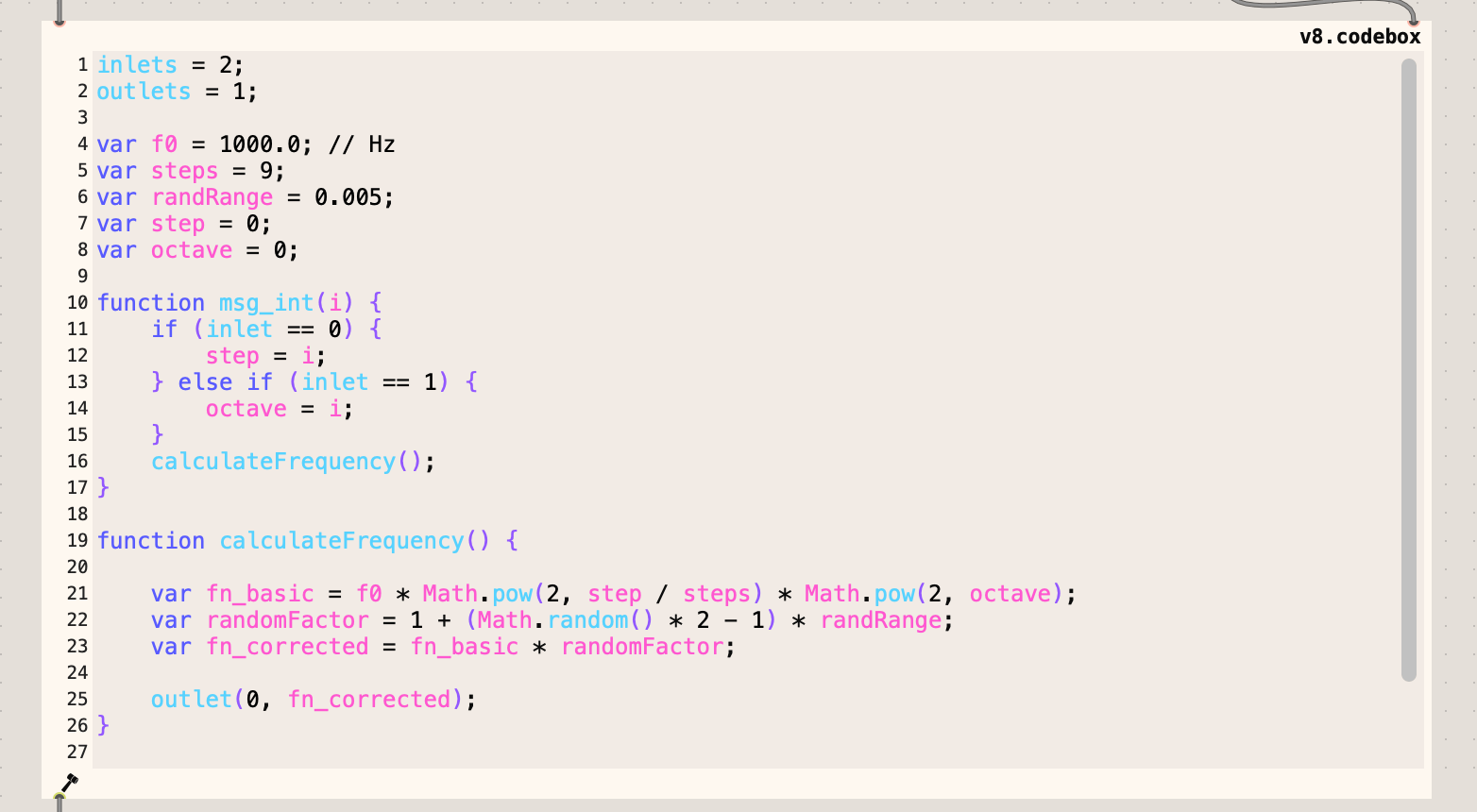
A key element in understanding the resonance of Stria is the Stria scale, designed by Chowning himself. Rather than following conventional twelve tone equal temperament or just intonation, Chowning based the system on a nine tone equal temperament that divides the octave into nine equal steps. He then introduced the idea of a pseudo octave, a slight adjustment applied to each step to refine the basic frequencies.
The pseudo octave preserves the sense of an octave while subtly modifying the frequency ratios across the scale. This concept concerns pitch design rather than timbre. Through this adjustment, the overlapping of partials generates a more dimensional form of modulation.
In FM synthesis, the ratio between a carrier frequency and a modulator frequency is often described with specialized terminology. Chowning intentionally used noninteger ratios, symbolically including the golden ratio phi which is approximately 1.618. This approach creates complex interactions and graceful connections between partials that would not normally combine smoothly. As a result, the system produces a vivid and fluid resonance that cannot arise from simple integer based harmonic structures. Even a single note carries layers that shift in a spatial manner over time, forming an acoustic environment that recalls the spirit of spectral music.
Striaの響きを語る上で欠かせないのが、Chowning自身が設計したStria scaleです。 Chowningは従来の12平均律や純正律に従うのではなく、オクターブを9等分した9平均律(nine-tone equal temperament)を基礎に据えました。その上で、各ステップの基本周波数を微妙に補正する「疑似オクターブ(pseudo-octave)」の概念を導入しています。
pseudo-octaveは、オクターブ感を保ちつつスケール全体の周波数比を微調整するもので、音色ではなく音程の設計に関わる考え方です。この補正により倍音が重なり合う際のモジュレーションが立体的な響きをもたらします。
さらに、FM音響合成では後述する専門用語になりますがキャリア周波数とモジュレータ周波数の比率を、整数比ではなく非整数比、例えば象徴的に黄金比 φ ≈ 1.618 に設定することで、本来調和しない倍音同士の複雑な干渉や美しい連結を生み出すことを意図しています。 この方法により、単純な整数比による自然倍音では得られない立体的で流動的な響きが生まれ、単音であっても時間の経過とともに音の層が立体的に変化する、まさにスペクトル音楽的な音響空間が生成されます。
部分音の連結と立体感
部分音の連結と立体感
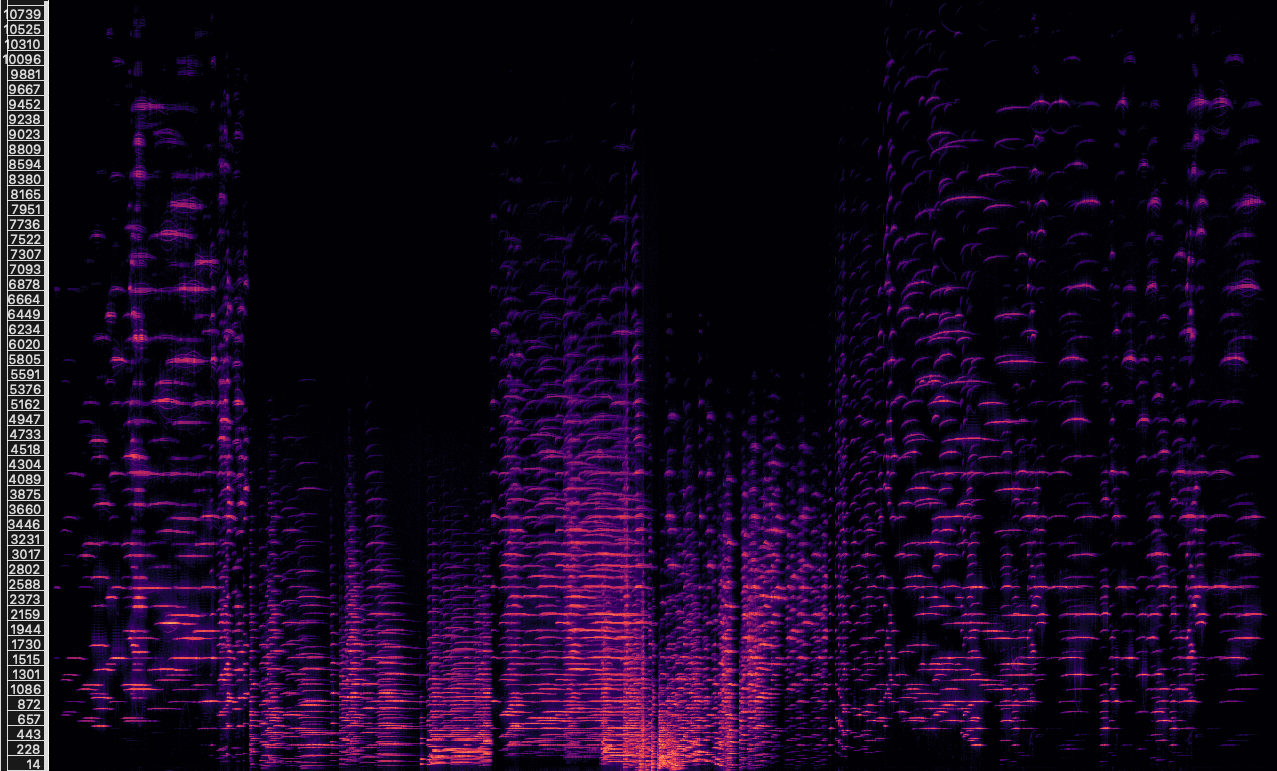
A notable feature of the Stria scale is that partials are shared and connected across multiple notes. When some overtones overlap at different pitches, a single tone can produce a sense of multiple layers resonating simultaneously, and as the lines of sound intertwine and move gently, they are perceived by the ear as continuous frequency lines (Stria, meaning “lines” or “striae”).
The overlapping and interference of these partials create a temporal continuity resembling complex patterns drawn in sound, forming a rich and ambiguous sonic space that is neither a clear chord nor noise. One might even say that this bears a resemblance to nineteenth-century compositional practices in which modulation is carried out continuously around common tones.
Stria scale の特筆すべき特徴は、部分音が複数の音にまたがって共有されながら連結する点にあります。異なるピッチでの一部の倍音が重なることで、単音でありながら複数の層が同時に響く立体感が生まれ、音の線が絡み合いながら緩やかに動くことで、耳には連続的な周波数の線(Stria=筋・線)として知覚されます。
この部分音の重なりと干渉が、まるで音響上に描かれた複雑な筋模様のような時間的連続性を生み出し、明確な和音でもノイズでもない曖昧で豊かな領域を形作ります。共通音を軸に連続的に転調を繰り返していく19世紀的な作曲表現に類似しているといえるかもしれません。
IRCAMでの研究と作曲理論
IRCAMでの研究と作曲理論
The design of Stria is closely connected to the research Chowning carried out at IRCAM. In the late nineteen seventies he conducted a mathematical investigation of FM synthesis at IRCAM and linked these findings directly to compositional practice. Relationships among frequency ratios, modulation indices, and durations were organized into a coherent system, making it possible to treat subtle timbral variations as structural elements within a composition. As a result, the motion and layered architecture of sound in Stria are not merely technical demonstrations but are integrated into the overall form of the work.
During this process Chowning also developed a compositional theory that expanded traditional Western concepts of harmony and melody. In conventional music, melody, harmony, and rhythm form the core materials. In Stria, however, the internal structure of the spectrum, namely the partials themselves, assumes the role of harmony.
The introduction of the golden ratio, non integer ratios, nine tone equal temperament, and pseudo octaves, along with the delicate interference patterns produced by the overlap and connection of partials, allows timbre to function as a generator of motion and stratification along the temporal axis. In this way Stria elevates FM synthesis beyond a technique for producing timbre and turns FM into the very basis of musical form.
Striaの設計は、ChowningがIRCAMで行った研究とも深く関わっています。1970年代後半、彼はIRCAMでFM音響合成の理論を数学的に分析し、作曲実践に結びつける作業を行いました。周波数比、変調指数、持続時間などの関係性が体系的に整理され、音色の微細な変化を作曲の構造要素として操作できる手法が整えられたのです。これにより、Striaの音の動きや層構造は単なる技術表現にとどまらず、作品全体の構造と一体化しました。
さらにChowningは、この過程で西洋の和声や旋律の概念を拡張する作曲理論を構築しました。従来の音楽ではメロディーとハーモニー、リズムが中心でしたが、Striaではスペクトルの内的構造、すなわち倍音がそのものが和声の役割を担っています。
黄金比や非整数比、9平均律や疑似オクターブの導入、さらに部分音の重なりと連結による微細な干渉は、音色を作るだけでなく、時間軸に沿った音の動きや層構造を作曲的に機能させることを可能にします。こうしてStriaは、FM音響合成を単なる音色を作る手段に留まらず、FMが楽曲構造そのものとなる音楽を実現しています。
Basic Theory of FM Synthesis
FM音響合成の基本理論

Cycling '74 Max 9
Download Max Patch BasicFMSynthesis.maxpat
FM sound synthesis is a technique in which the frequency of a carrier tone is rapidly varied by the frequency of a modulator tone. As a result, the ear perceives new frequency components called sidebands that are different from the carrier itself. A simple sine wave is transformed into a waveform that contains many partials and produces a richer timbre.
The principle can be understood as an extreme acceleration of vibrato. A slow vibrato that might occur only a few times per second is pushed to hundreds or thousands of cycles per second, and the range of pitch deviation is expanded across several octaves. The vibrato motion itself is no longer heard. Instead, new partials appear at mathematically predictable frequencies and strengths, and these partials are perceived as the resulting sound. This principle forms the basis of the synthesis method.
FM音響合成は、キャリア(基本音)の周波数をモジュレータ(変調音)の周波数で高速に揺らすことで、耳にはキャリアとは異なるサイドバンドと呼ばれる新しい周波数成分が現れる技術です。単純な正弦波が複数の倍音を含むリッチな音色の波形に変化します。
これは、通常1秒間に数回程度の低速のビブラートを数百回、数千回スピードに極端に速くし、そのピッチ変化幅も数オクターブにわたるように拡張する原理で、揺れそのものは聞こえず数学的に説明できるような周波数と強度で新しい倍音が付加され音として知覚される原理を利用した音の合成方法です。
Basic Terms
基本用語
- Carrier - The fundamental frequency that serves as the central pitch. It is perceived as the pitch of the sound.
- Modulator - A signal that periodically modulates the frequency of the carrier. When applied at very high speed it produces sidebands and increases the complexity of the partial structure.
- Modulation Index - The depth of frequency deviation that the modulator imparts to the carrier. A large index generates many complex partials. A small index yields gentler partial structures. An index of zero produces no additional partials.
- Frequency Ratio - The ratio between the modulator frequency and the carrier frequency. Integer ratios create regularly aligned harmonic partials. Non integer ratios produce slightly displaced and complex inharmonic partials.
- Sidebands - New partials generated around the carrier frequency. Their positions and strengths depend on the modulation index and the frequency ratio.
- キャリア(Carrier) - 音の中心となる基本周波数。ピッチとして知覚されます。
- モジュレータ(Modulator) - キャリアの周波数を周期的にモジュレーションさせる信号。高速で作用させることでサイドバンドを生成し、倍音の複雑さを加えます。
- 変調指数(Modulation Index) - モジュレータがキャリアに与える周波数の揺れ幅。Indexが大きいほど音は複雑な倍音を多く発生させ、小さいと倍音は穏やかになり、ゼロでは倍音を発生させません。
- 周波数比(Frequency Ratio) - モジュレータ周波数とキャリア周波数の比。Ratioが整数の場合、自然倍音が規則的に整列し、非整数比では微妙にずれた複雑な非整数倍音が生まれます。
- サイドバンド(Sidebands) - キャリア周波数の周囲に生成される新しい倍音の周波数成分。変調指数や周波数比によって位置や強さが決まります。
Basic FM Demo
FMの基本デモ
Cycling '74 Max 9
Download Max Patch BasicFMSynthesis.maxpat
In this demo, you can understand both aurally and visually how changing the frequency ratio between the carrier and the modulator affects the harmonic structure, how increasing the modulation index increases the number of partials, and how the waveform remains unchanged as long as the ratio is constant, even if the carrier frequency changes. The fundamentals of FM synthesis are created with these two oscillators. FM synthesizers produced by YAMAHA or KORG with six oscillators are designed so that the sound generated by a pair of oscillators can act as a modulator for another oscillator, or multiple differently configured pairs can be arranged in parallel to produce more complex partials.
By varying the modulation index over time with an envelope or other means, it is also possible to create sounds in which the amount of partials changes dynamically. One of the defining features of FM synthesis is that even with a small number of oscillators, careful combinations can produce extremely complex and diverse sounds. The potential of this sound design approach is far from being fully explored.
このデモではキャリアとモジュレーターの周波数比が変化すると倍音構成がどのように変化し、インデックスが高くなるとどのように倍音の量が増え、また、キャリアの周波数が変わってもレシオが同じである限り波形が変わらないことが音とビジュアルで理解できると思います。FM音響合成の基本はこの2つのオシレーターで作り出されるもので、YAMAHAやKORGから製品化されている6個のオシレーターがあるFMシンセはこの2つのオシレーターで作り出した音自体をモジュレーターと考えて、さらに別のオシレーターをモジュレーションさせたり、設定が異なるペアを複数並列させたりしてより複雑な倍音を作り出せるように設計されています。
インデックスはエンヴェロープなどで時間的に変化させることで倍音の量が時間的に変化していく音作りも可能になります。少ないオシレーターでもその組み合わせ方の工夫でとてつもなく複雑で多様な音を作れるのがFM音響合成の特徴で、まだまだその音作りの可能性が出尽くしているとは言えないのではないでしょうか。
Golden ratio FM with nine tone equal temperament
黄金比と9平均律を使った非整数倍音のFM音響合成
Cycling '74 Max 9
Download Max Patch
StriaFM.maxpat
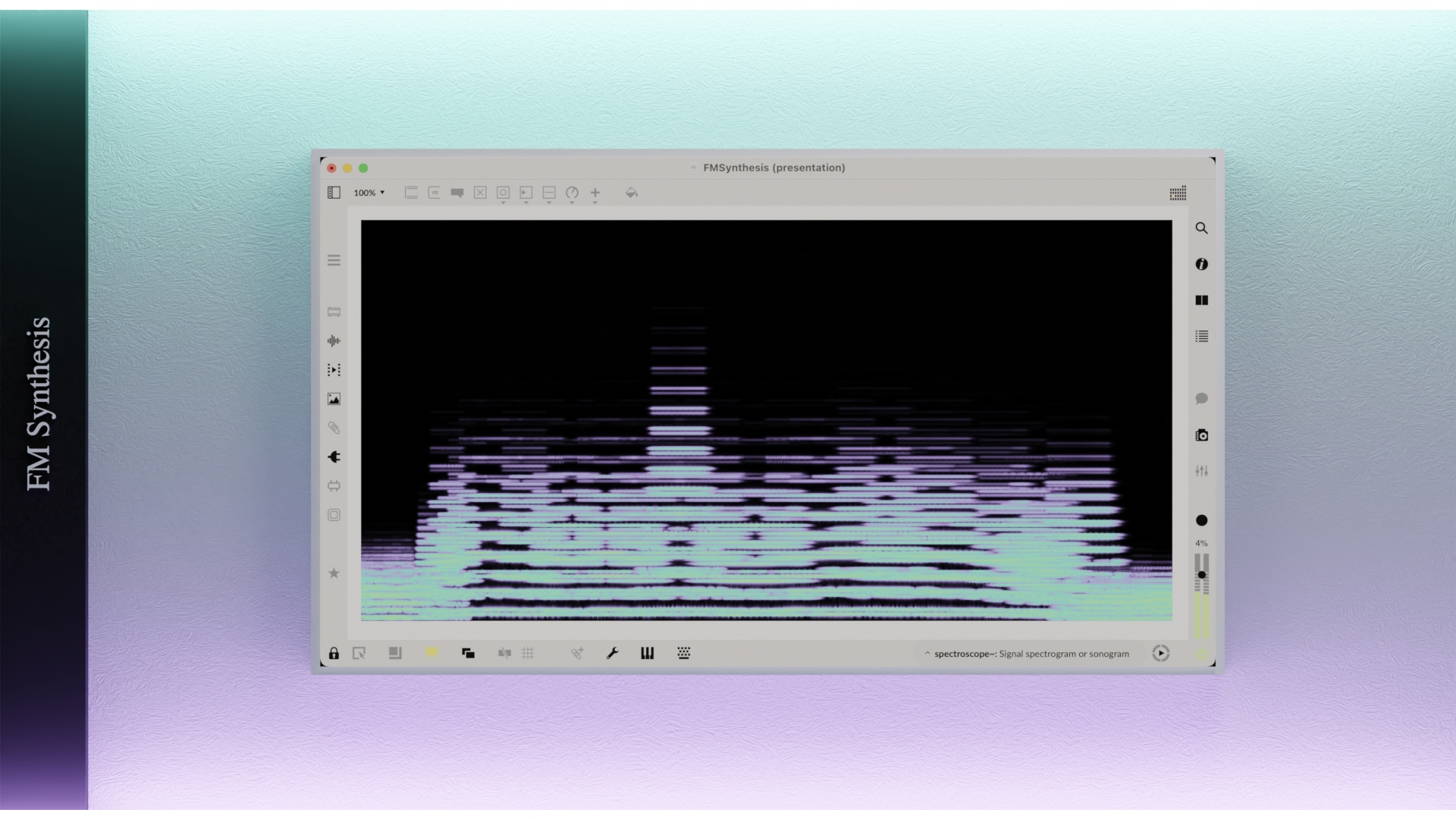
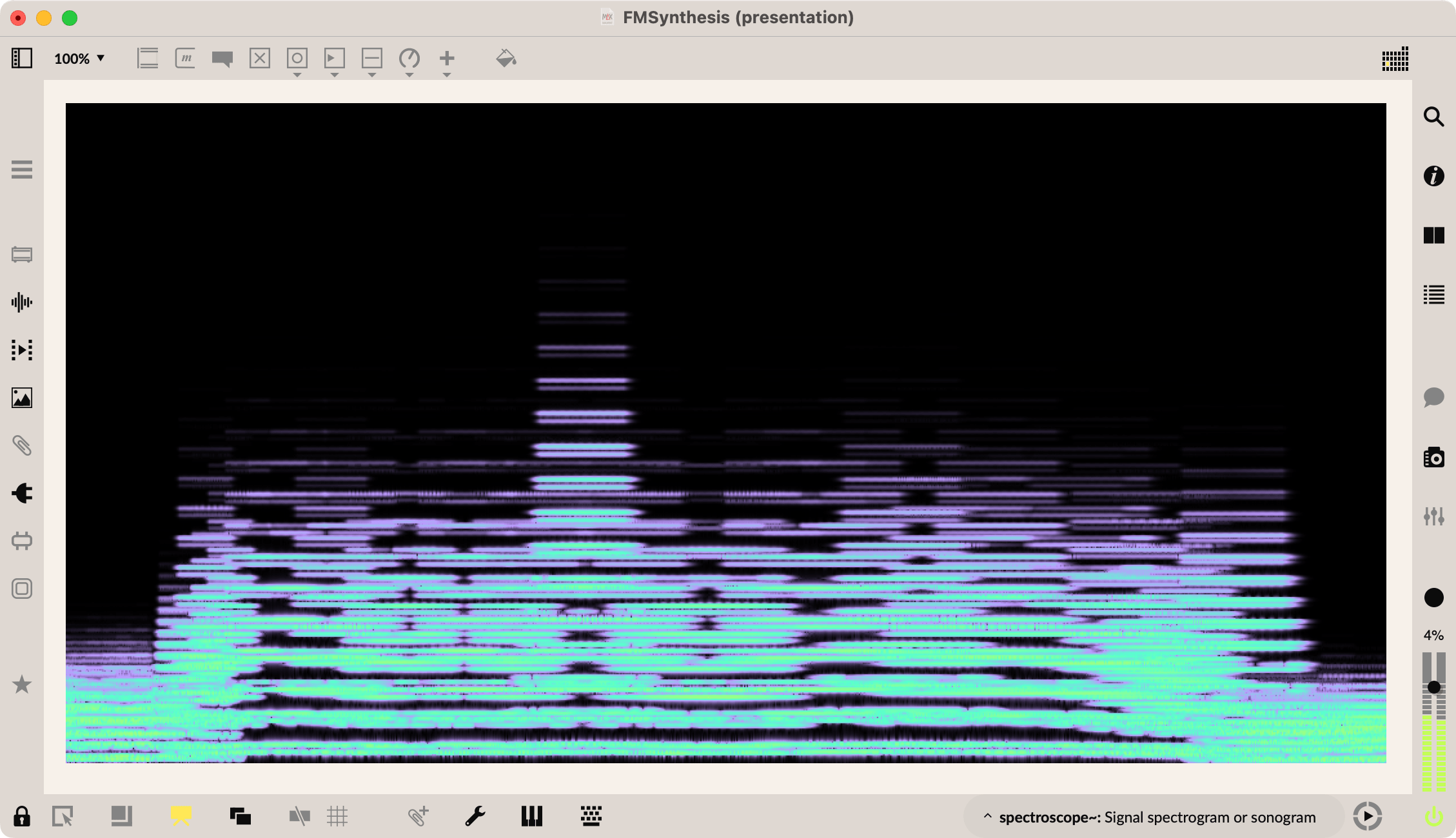
It is a simple two operator FM synthesis piece, yet it follows the inspiration of Stria by adopting the golden ratio and its powers as frequency ratios together with nine tone equal temperament. Inharmonic partials often produce dissonant colors even in single tones. However, because partials at different pitches can share certain frequency components, there are moments in which the harmony connects smoothly, similar to sustained common tones or pivot like modulations. This can be heard and also seen in the spectrogram. The example may offer one approach to working with dense and murky sonorities that are often difficult to use as musical material.
シンプルな2オペレーターのFM音響合成ですが、Striaの着想に忠実にレシオに黄金比とその冪乗の数値、9平均律を採用した音楽です。非整数倍音は単音でも調和しない不協和な音ですが、異なるピッチにおける倍音の周波数成分が部分的に共有されるため、保続音や共通音転調のようにスムースに和声が連結される瞬間が生じているのが耳でもスペクトログラムの絵でもわかるのではないかと思います。簡単には音楽の素材として利用しにくい濁った響きの音をどう扱うかの実例の一つになるかもしれません。
Modern FM Synth
FMシンセサイザーの現在
Ableton OP-2 Max for Live Device https://akihikomatsumoto.sellfy.store/p/ableton-op2/
FM synthesis completely transformed the music of the 1980s, which had been dominated by analog electronic sounds, with its dazzling and complex partials. The timbres used at that time are now often perceived with a sense of nostalgia. Meanwhile, from the 1990s onward, UK artists gradually explored new terrain by creating wobble basses with FM. This approach differs fundamentally from the web table synthesis popular in the 2010s, which typically controls aggressive partials through modulation and creates melodies by manipulating pitch. FM also pairs well with approaches that alter sound in ways other than directly shaping pitch. This video is a demo of a two oscillator FM synthesizer designed specifically for such bass music applications.
By modulating the depth of the FM index with geometric patterns synced to BPM, the partials appear to dance. Despite the simple two oscillator interface, both the carrier and modulator can use waveforms other than sine waves. This achieves complexity in a different way from the YAMAHA DX7, which combined six oscillators to generate rich partials. Designing interfaces and parameters that allow the maximum variety of sounds with minimal operation remains a key focus in modern FM synthesizer development.
FM音響合成はそれまでアナログの電子音が中心だった80年代の音楽を一気にその煌びやかで複雑な倍音で塗り替え、その当時使われていたような音色は現在では懐かしさを伴って捉えられると思います。 その一方で、90年代から徐々にFMでワブルベースを作るようなUKのアーティストたちが別の地平を開拓しています。2010年代以降のウェブテーブルシンセシスが得意とするような、アグレッシブな倍音をモジュレーションで制御し、ピッチの操作でメロディーを作っていくアプローチとは根本が異なる方法で音に変化を与えるアプローチもまたFMと相性がいいものです。この動画はそのようなベースミュージックでの使われ方に特化した2オシレーターのFM音響合成のデモです。
Depth = FM Indexの値の深さをBPMに同期させた図形的パターンでモジュレーションさせることで倍音が踊るような仕組みになっています。2オシレーターのシンプルな操作性がありながら、キャリアもモジュレーターもサイン波以外を選べるようになっています。このことで6個のオシレーターを組み合わせて複雑な倍音を得ていたYAMAHA DX7とは別の方法で複雑さを担保しています。いかに最小限の操作で最大限いろいろな音をだせるようにするかのインターフェースやパラメータの工夫が現在のFMシンセ開発における重要なポイントかもしれません。
Korg Opsix Preset Pack
https://korg.shop/sound-libraries/opsix/neo-grime.html
Neo Grime is an emerging genre in the bass music scene since 2015. Leveraging the versatile opsix environment, ranging from FM to additive and subtractive synthesis, this pack featurees dazzling FM synthesizer leads, destructively detuned bass, high-resolution drum kits and ethereal floating pads. The pack encapsulates the unique and beautiful tones characteristic of Neo Grime, showcasing the artist's expertise in navigating the expansive opsix environment. Produced by Akihiko Matsumoto.
Reference
Matteo Meneghini . An Analysis of the Compositional Techniques in John Chowning’s Stria. MIT Press https://direct.mit.edu/comj/article-pdf/31/3/26/1854836/comj.2007.31.3.26.pdf MIT Press Direct+2MIT Press Direct+2
Michael Clarke, Frédéric Dufeu, Peter Manning . Using Software Emulation to Explore the Creative and Technical Processes in Computer Music: John Chowning’s Stria, a case study from the TaCEM project. https://eprints.hud.ac.uk/id/eprint/30698 University of Huddersfield
Laura Zattra. Analyse de Stria https://brahms.ircam.fr/analysis/Stria/ Ressources IRCAM+1
Laura Zattra. The Assembling of Stria by John Chowning: A Philological Investigationhttps://www.academia.edu/1763068/The_assembling_of_Stria_by_John_Chowning_A_philological_investigationAcademia
Curtis Roads. The Computer Music Tutorial. MIT Press https://mitpress.mit.edu/9780262680820/the-computer-music-tutorial/
Charles Dodge. Computer Music: Synthesis, Composition, and Performance. Schirmer Books https://amzn.to/463ehCu
YAMAHA. CFM Tone Generators and the Dawn of Home Music Productionhttps://europe.yamaha.com/en/musical-instruments/keyboards/explore/synth-40th/history/chapter02/index.html
Jerry Kovarsky. DISCOVERING DIGITAL FM: JOHN CHOWNING REMEMBERShttps://hub.yamaha.com/keyboards/synthesizers/discovering-digital-fm-john-chowning-remembers/?utm_source=chatgpt.com